

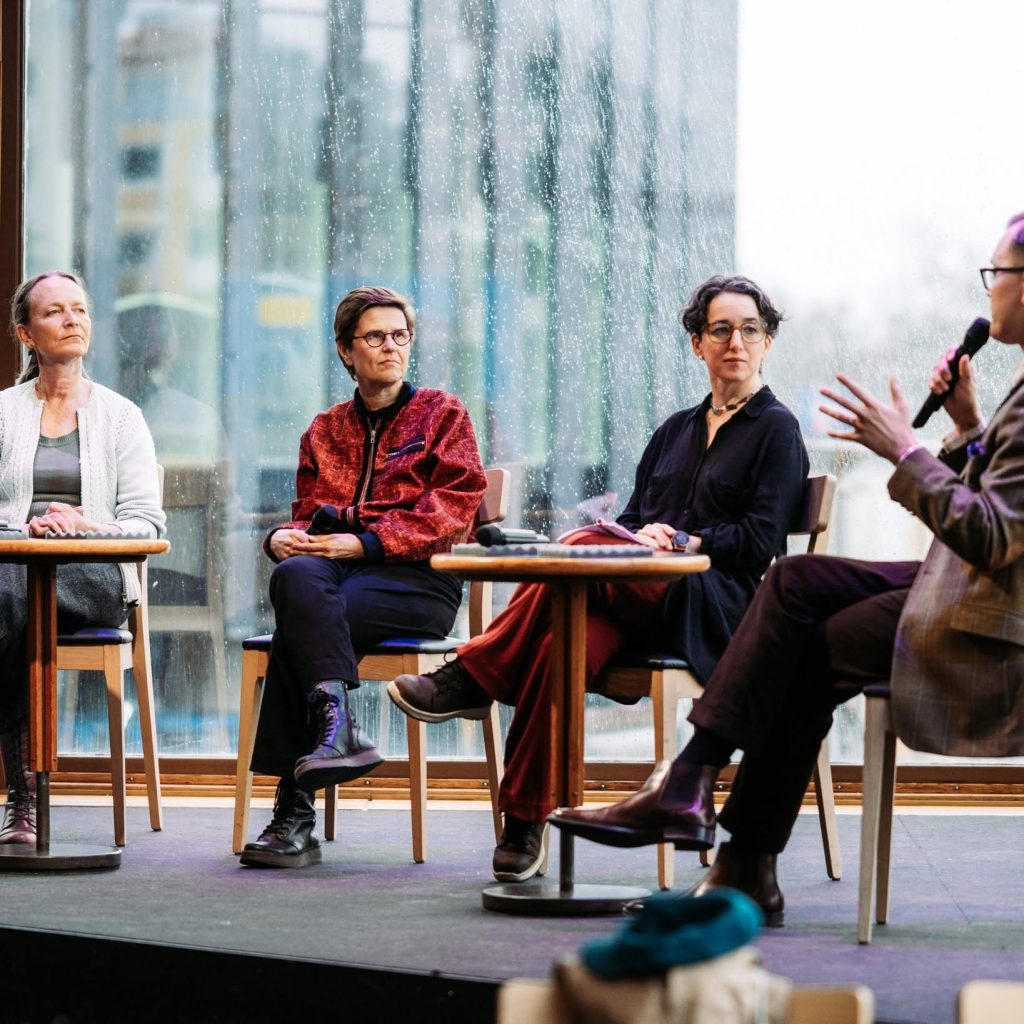
This text is based on an invited keynote talk given by Kaija Kaitavuori at the Audience Ambassadors Seminar held at the Turku City Theatre in March 2026.
In one of his essays, Charles Leadbeater[1] has outlined the functional relationships that form between people using the prepositions to, for, with, and by. I draw here on Leadbeater’s framework, but the application and interpretations are my own.
To refers to situations where we are the objects of action — things are done to us. We are largely passive recipients, and someone else decides and acts. The relationship involves an element of expertise, authority, or power, such as a doctor, a manager, or a police officer. We may consciously submit to this position and give our consent: a recruit places themselves under command, a patient submits to a medical procedure, or a volunteer participates in an activity where someone else assigns tasks. However, this arrangement also potentially involves control, discipline, subordination, and even violence. We may be struck, commanded, fined, or punished for violations, even against our will. Modern society is structured so that public disciplinary power is entrusted to authorities.
In the for category, we think of various services and activities provided for us. Such situations occur in everyday life — “Shall I go to the store for you?” “Can you write a recommendation for me?” — but a large part of for-type activity is professional and has its own economic structure: the service sector. Things are planned from the recipient’s perspective to serve their needs, and the subject of service is the client or customer who decides to initiate it: I book an appointment with a hairdresser, I enroll in a language course. The provider, however, occupies an expert position relative to the recipient — they know or can do something better than the client; for example, I cannot cut my own hair. Service provision is based on lack and need — although economically the provider is, in turn, dependent on clients.
There is often only a subtle difference between the to and for categories, and sometimes to-type action disguises itself as for-type service. Commercial and public services may present themselves as serving us, even when the goal may be to benefit from us and our money or to control us. Filling a lack or need creates a position of power, which can turn into a violation of autonomy. How often has child discipline been justified as love: “I do this for your own good.”
With describes how we do things together with others. This type of activity is based on dialogue and negotiation and assumes that people have skills and capabilities, not just needs and deficiencies. Models of working together have been influenced by the development of digital platforms, which have lowered the threshold for participation and broken down hierarchical structures. Knowledge production is two-way here: people do not merely receive content but also comment on and further develop it. Activity based on interactivity and peer participation is also more efficient, as it draws on a larger pool of knowledge than when experts decide on behalf of others.
Finally, by emphasizes the actor’s independence and autonomy: this is done by me. Action stems from the initiative and motivation of individuals and communities; it is self-organized and free from hierarchical control. The role of society or institutions is to create the conditions for it.
Where does audience development in cultural organizations fall within this framework?[2] Roughly speaking: do we teach audiences content we have decided ourselves, do we build services for them, do we work together with them, or do we create opportunities for them to act independently? What kinds of encounters do different approaches produce? Everyone working in education and outreach must take a stance at least on whether they operate along the to–for axis or the with–by axis — whether the activity is controlling and reproductive or participatory and emancipatory.
In my view, New Performance Turku Biennale’s audience ambassador program reached toward the most challenging level: it aimed to equip participants to operate in a by-mode. The programme was built on two levels. First, a small group of participants received training that enabled them to draw on their own strengths and resources; in the second phase, they invited audiences to join. I will not go into how the training was organized — whether it was one- or two-directional.[3] Instead, I focus on the outcome, the second phase, where participants themselves planned and implemented activities: they made decisions about target groups and performances, and designed, prepared, and facilitated visits and related workshops.
From an institutional perspective, the most challenging aspect is usually the sharing of power. By allowing the ambassadors to act independently, NPTB relinquished part of its authority to define what happens around the festival program. By acting as a platform and providing tools and resources for others, New Performance Turku Biennale took on the role of a “host” described by Nina Simon.[4] This role does not mean passivity; it requires a great deal of work, support, and trust. When institutional staff do not control the content of activities, the institution shares its name and reputation with others. At the same time, it expands its contact surface with audiences.
For their part, the ambassadors had to reflect on their relationship both to the institution and to participants. The activity was largely pre-designed for the target group and involved collaboration — for and with. Many reflected on their role as facilitators: the surprises brought by performances, the difficulty of reaching people, what motivates participants, the demand to create space for their needs and for dialogue, and the fact that people do not always act as the facilitator wishes. The ambassadors themselves were also open and courageous.
Kaija Kaitavuori
[1] Charles Leadbeater, The Art of With, Cornerhouse, 2009.
[2] Or what does leadership in an organization, company, or project look like under these categories?
[3] To avoid misunderstandings, it should be noted that one-directional activity — deciding for participants what information they need and providing it — can be justified. Sharing information is, in my view, an important part of audience work.
[4] Nina Simon identifies levels of participation as “Contribution, Collaboration, Co-creation, and Hosting.” Especially with and byshare much with these. Nina Simon, The Participatory Museum, 2010.